Write Meeting Notes That Make the Next Step Obvious
A hypothetical product meeting shows how to separate decisions, owners and open questions so the record remains useful after the call ends.
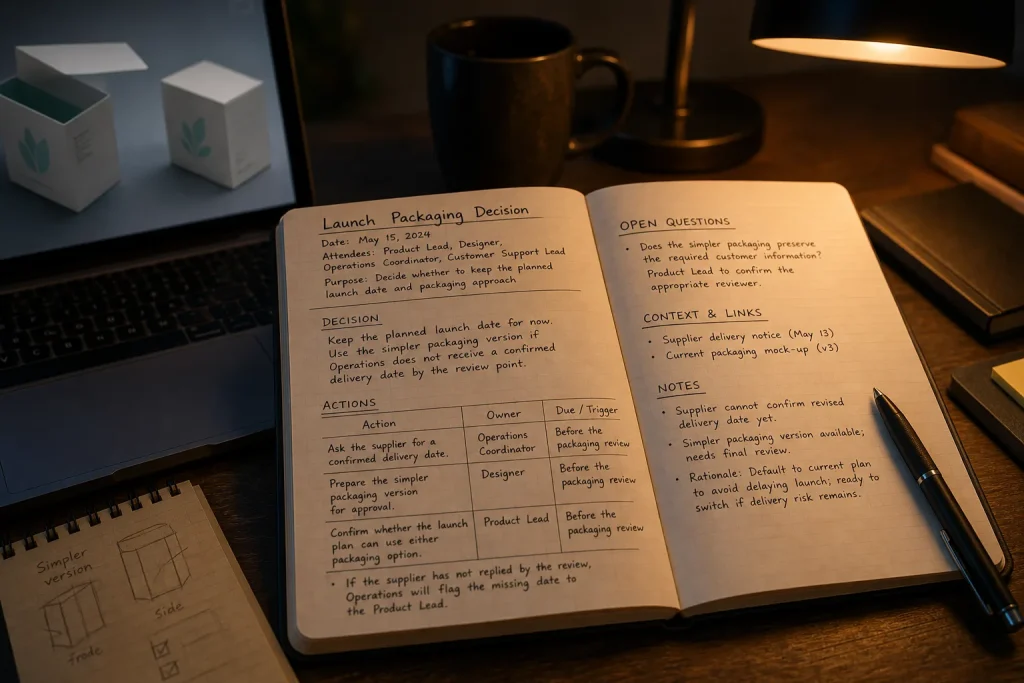
The meeting ends with a decision about a delayed product launch, but the notes say only, “Discussed timeline; follow up.” By the next morning, one person thinks the launch date has moved, another believes the team is waiting for a supplier, and the person who was meant to check has no idea they own the task. The notes have preserved a topic, not an outcome.
Meeting notes do not need to reproduce the conversation. Their job is to let someone who was there—or missed the call—answer a few practical questions: What did we decide? Who is doing what? By when or at what point will it be revisited? What remains unresolved? A compact structure can make those answers visible without turning the note-taker into a court stenographer.
Start with the meeting’s working context
Imagine a small team preparing a product launch. A supplier has warned that a packaging component may arrive later than planned. The meeting includes the product lead, a designer, an operations coordinator and a customer-support lead. They need to decide whether to keep the current launch date, change the packaging, or wait for a firmer delivery update.
Before the call, the note-taker opens a shared document and adds a plain heading: “Launch packaging decision.” Under it go the date, attendees and purpose. The purpose is written as a decision to make, not a vague label such as “Launch discussion.” That small distinction gives the notes a test: if the group leaves without a decision, the record should say so.
A useful header is modest. It can include the meeting name, date, participants and a link to relevant material, such as the supplier’s delivery notice or the current packaging mock-up. Keep source material separate from decisions. A linked mock-up may help explain a choice, but it does not tell a returning reader whether the team approved it.
For recurring meetings, a consistent location and naming pattern help people find the record. A shared team folder or a channel’s pinned document can work. The method matters less than making the note accessible to the people expected to act on it. If the document has restricted permissions, the most elegant decision record is still just a private thought with headings.
Record the decision as a sentence
During the hypothetical meeting, the team considers three options. The supplier cannot yet confirm the revised delivery date. The designer says a simpler packaging version is available, but it needs a final review. The group agrees to keep the planned launch date for now and use the simpler version only if the supplier cannot confirm delivery by the agreed review point.
The note-taker records the decision in direct language: “Decision: Keep the planned launch date for now. Use the simpler packaging version if Operations does not receive a confirmed delivery date by the review point.” This sentence captures both the present choice and the condition that could change it.
“We discussed keeping the launch date” would be weaker. It records a topic and leaves the reader to infer whether agreement happened. “The launch date is unchanged” would also be incomplete because it omits the condition and the alternative. The decision sentence should say what the group chose, not merely what people talked about.
If the group has not reached agreement, say that plainly. For example: “No decision: the team is waiting for a confirmed supplier date before choosing packaging.” Then record what information is missing and who will obtain it. Uncertainty is useful when it is labeled. Uncertainty disguised as a decision tends to acquire confidence while being forwarded.
Give every follow-up an owner and a trigger
The meeting produces three actions. Operations will ask the supplier for a confirmed delivery date. The designer will prepare the simpler packaging version for review. The product lead will check whether the launch plan can accommodate either option. The notes record each action with one accountable owner and a clear completion point.
- Action: Ask the supplier for a confirmed delivery date. Owner: Operations coordinator. Due: Before the packaging review.
- Action: Prepare the simpler packaging version for approval. Owner: Designer. Due: Before the packaging review.
- Action: Confirm whether the launch plan can use either packaging option. Owner: Product lead. Due: Before the packaging review.
“Operations and Design will follow up” sounds collaborative but makes responsibility hard to locate. If two people must contribute, identify one owner for coordinating completion and name the other person’s contribution in the action description. Shared work can have several hands; the note should still show whose turn it is to move it along.
Use a date when the group agrees one. If there is no date, use an event or trigger that can be recognized, such as “before the packaging review” or “after the supplier replies.” Avoid inventing a deadline to make the table look tidy. A made-up due date is not clarity; it is decoration with a calendar attached.
When a task depends on another person’s response, record the next action if the response does not arrive. For instance: “If the supplier has not replied by the review, Operations will flag the missing date to the product lead.” This turns a follow-up from a hope into a small, observable sequence without pretending the team controls the supplier.
Keep open questions separate from commitments
The team still needs to know whether the simpler packaging meets a customer-information requirement. No one can answer during the call. The note-taker places the issue under “Open question,” rather than squeezing it into the decision or assigning an action to someone who has not agreed to take it.
That section might say: “Open question: Does the simpler packaging preserve the required customer information? Product lead to confirm the appropriate reviewer.” If a person accepts the task in the meeting, the question can also have an owner and a due point. Until then, the record should show that responsibility remains unassigned.
This distinction prevents a common source of accidental obligation. A name mentioned in conversation is not automatically an owner. “Could Maya check?” is a proposal, not an agreement, unless Maya accepts it. The note-taker can ask, “Maya, are you taking that?” or record “Owner to be assigned” and leave the gap visible for the meeting lead to resolve.
It is also useful to record a brief rationale when it helps explain the decision later. Here, the team is preserving the launch date because the simpler version offers a fallback if the supplier remains uncertain. One sentence is enough. A long transcript of every objection would make the central choice harder to find, not easier to understand.
Hypothetical worked example: the packaging review
Starting situation: The product team expects to launch with its current packaging, but the supplier has warned of a possible delay and has not confirmed a delivery date. The group has a simpler packaging mock-up, an upcoming review, and no agreement yet that the alternative satisfies customer-information requirements.
Inputs and constraints: The planned launch date remains in place for now. The supplier’s response is uncertain. The simpler version needs approval. The notes must identify who will obtain the missing information and must not present the fallback as already approved.
Actions taken: The note-taker records the decision to keep the date provisionally and use the simpler version only if no confirmed supplier date is available by the review. The operations coordinator owns the supplier request; the designer owns the revised mock-up; the product lead owns checking the launch plan. The customer-information issue remains an open question until the product lead identifies an appropriate reviewer. The review itself is named as the trigger for reconsidering the choice.
Expected result and tradeoff: A teammate returning to the document can see the current plan, the condition that may change it, and the people responsible for the next inputs. The record does not resolve the supplier delay or settle the approval question. It does make those gaps visible, which is more useful than quietly implying they have disappeared.
Close the record without adding a transcript
After the meeting, the note-taker gives the document a brief cleanup. They remove repeated discussion, preserve the decision and action owners, and check that each follow-up has a due point or trigger. If wording is uncertain, they confirm it with the person who made the decision rather than polishing a guess into an official-sounding sentence.
The final note can be organized with a few stable labels: “Decision,” “Actions,” “Open questions,” and, when needed, “Context.” Put the decision near the top. Keep actions in a short list or table that remains readable in the team’s shared tool. If the platform makes tables awkward on mobile, use labeled lines instead; a format that collapses into visual soup is not a format.
Send or post the link where participants expect to find it, and mention any unassigned owner or unresolved issue that needs attention. This is not a demand that everyone reread every sentence. It is a practical way to surface the parts that could block the next move.
When the next meeting begins, carry forward only the unfinished actions and questions. Mark completed items as complete or remove them according to the team’s convention, while leaving the original decision available for context. The useful note is neither a transcript nor a scrapbook. It is a compact record of what changed, who will act, and what condition should prompt the next decision.
A reader should be able to scan the page and identify the next move without asking the note-taker to reconstruct the conversation. If that requires a brief clarification, correct the record while the participants still remember the exchange. The quiet advantage of precise notes is not that they prevent every misunderstanding; it is that they give the team a shared place to notice and repair one before it becomes the plan.